
May 26, 2026
Why dvLED is Growing in Outdoor Signages
Outdoor dvLED Market Outlook
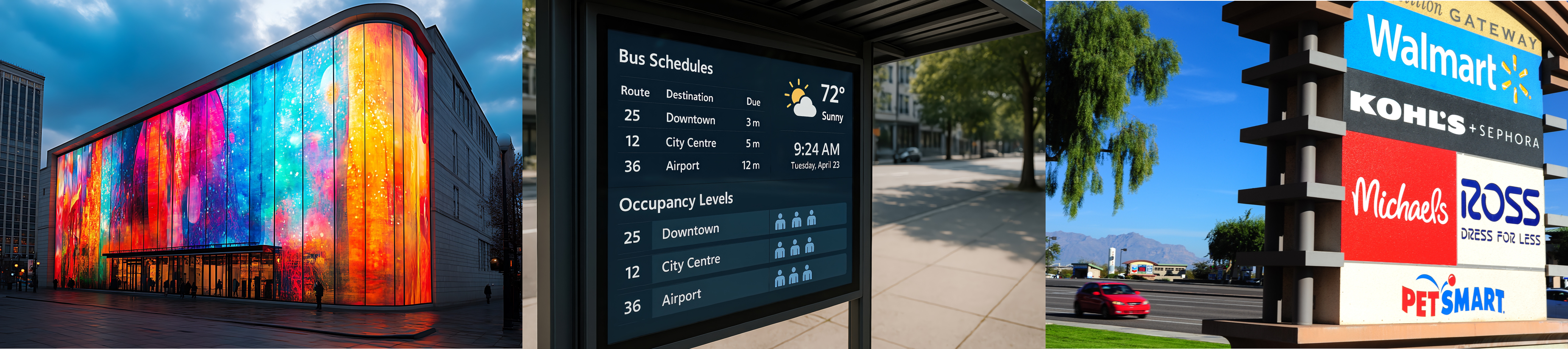
Demand for the outdoor dvLED market has increased significantly, driven by multiple factors. Advertisers increasingly prefer dvLED walls because they are effective at capturing audience attention. At the same time, the expansion of the sports and entertainment industry has accelerated the development of outdoor dvLED displays in stadiums and arenas, enhancing fan experiences and viewing quality. In addition, growing infrastructure investments are driving adoption in retail spaces and transportation hubs.
On the supply side, the cost of outdoor dvLED displays has continued to decline. SMD technology now accounts for more than 60% of the outdoor LED market. In addition, Chinese manufacturers have led to oversupply and intensified competition. Furthermore, improvements in power consumption efficiency have reduced the cost of Power Supply Units (PSUs). These factors continue to drive price reductions in the outdoor dvLED market.
While dvLED adoption is accelerating, LCD technology continues to serve cost-efficient and high-resolution display applications, particularly in small- to medium-sized outdoor signage. As a result, technology selection is increasingly based on application requirements, viewing distance, budget, and installation environment.
Key Reasons for dvLED Market Demand Growth
· Advancement of Digital Out-of-Home Advertising
· Expansion of the Sports & Entertainment Industry
· Retail & Transportation Digitalization
Key Reasons for Outdoor dvLED Price Reduction
· SMD Technology
· Oversupply and Intensified Competition
· Improved Power Efficiency
Challenges for dvLED
LCD has been widely used in outdoor signage and continues to dominate small- to medium-sized signage applications. As a result, outdoor dvLED adoption has traditionally been concentrated in large-scale installations.
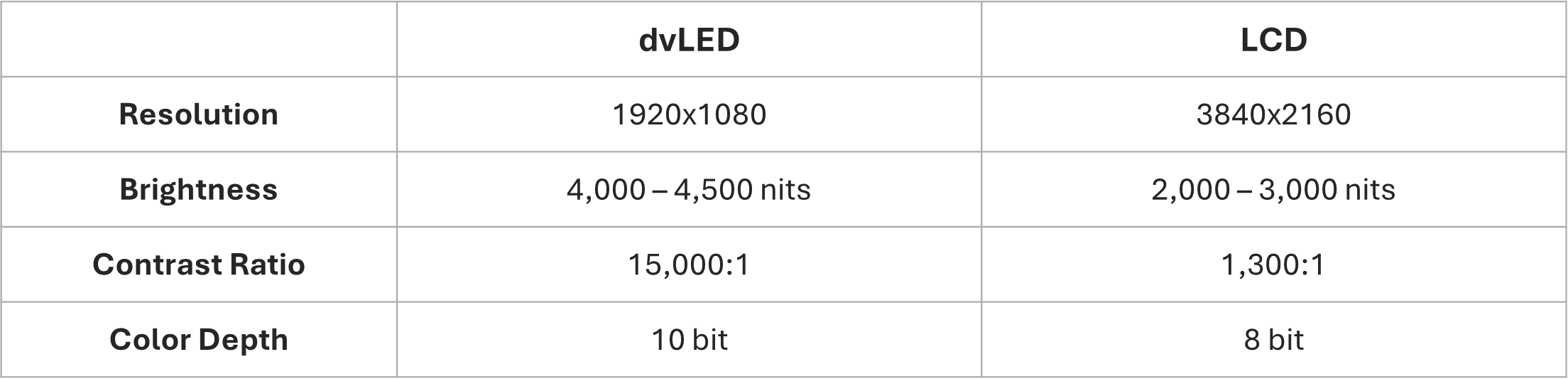
Why has dvLED adoption remained limited in small- to medium-sized signage? The primary reasons are its perceived resolution differences compared to LCD and its higher upfront cost. While LCD typically offers 3840×2160 resolution, dvLED is generally limited to FHD/UHD configurations.
However, despite the higher initial investment, dvLED can deliver a significantly higher return on investment (ROI) over time.
Maximum ROI
While LCD offers higher resolution (3840x2160) compared to dvLED (1920x1080), dvLED provides strong performance advantages in brightness, contrast ratio, and color depth, particularly in outdoor environments exposed to direct sunlight.
In addition, dvLED eliminates the need for cooling systems required by LCDs, which can suffer from blackening effects under direct sunlight. From a maintenance perspective, dvLED allows individual module replacement, whereas LCD panels typically require full-panel replacement. dvLED also offers a longer lifespan of up to 100,000 hours (LCD: 50,000 hours), which reduces the total cost of ownership.
Outdoor-Optimized
BSI dvLED is designed to deliver high brightness, color uniformity, and long-term reliability in outdoor environments. It utilizes flip-chip (MIP) technology, in which the LED chip is mounted upside down with electrodes directly connected to the substrate.
By applying HyCon Coating with polyurethane resin, the panel achieves deep black levels, a high contrast ratio, excellent weather resistance, and a balanced combination of strength and flexibility. In addition, it is certified with IP65/66 rating for weather resistance and an IK08 rating for vandal-resistance. The panel also features a 100% full-aluminum structure for enhanced durability and stability.